Canada — Toward an Overhaul of the Marine Personnel Regulations: New Requirements and Transition
Context
The Marine Personnel Regulations (MPR 2007 – SOR/2007-115) form the basis of certification and professional obligations for Canadian seafarers. However, this regulatory framework no longer fully reflects international requirements (STCW, STCW-F, MLC 2006) or safety expectations (passenger management, fatigue, etc.).
Transport Canada is therefore preparing a comprehensive overhaul of the regulations (MPR 2025), with prepublication expected in fall 2025 in the Canada Gazette, Part I.
Objectives of the reform
The reform of the Marine Personnel Regulations (MPR) is primarily aimed at international harmonization through the integration of STCW, STCW-F, and the Maritime Labour Convention (MLC 2006). It is also part of a modernization approach, incorporating by reference Transport Canada’s technical publications, such as TP 2293 on examinations and certificates or TP 4957 on safety training.
From a safety perspective, a major change is the removal of the 500 gross tonnage threshold for training in passenger safety management, in order to cover all vessels, regardless of size.
Finally, the reform introduces a preventive dimension by launching specific consultations on crew fatigue management, a key issue for modern maritime safety.
Requirements to sit examinations leading to a certificate
The revised MPR provide for clarification and strengthening of the criteria for access to examinations:
Criterion | Description |
Mandatory prior training | Successful completion of validated modules (STCW courses, TP 2293, TP 4957). |
Documented sea service | Signed and verifiable service record book, meeting STCW thresholds. |
Health certificates and medical fitness | Medical examinations compliant with national and international standards. |
New competencies | Integration of passenger safety (all vessels, not only > 500 GT). |
Oral and practical examinations | Revision of content to include more elements related to emergency management. |
Grandfathering clause
As with previous revisions, Transport Canada is considering the inclusion of transitional provisions. The operating approach after the new MPR come into force could be as follows:
- Seafarers already engaged in a certification pathway could benefit from a grace period to obtain their certificate under the old rules; and
- A period of regulatory coexistence (often 2 to 5 years in STCW transitions) could be provided.
The exact terms will be specified at the time of prepublication in the Canada Gazette, Part I.
Practical impacts for the maritime industry
Shipowners should plan training updates now and support their crews in the transition to the new requirements.
Maritime institutions will need to adjust their programs, notably by integrating new modules related to passenger safety and by revising the relevant technical reference publications.
For their part, seafarers in certification should check whether a grandfathering clause applies to their situation and closely follow implementation timelines.
Finally, Transport Canada inspectors will be responsible for gradually applying these changes during inspections and certificate verification.
Next steps to watch
• Fall 2025: publication of the full draft of MPR 2025 in the Canada Gazette, Part I; and
• 2026–2027: phased entry into force, with transitional clause to be confirmed.
Summary
The overhaul of the MPR is a substantive reform that will have direct impacts on seafarer training, access to examinations, and competency management. Sector stakeholders should closely monitor:
• The new eligibility conditions for certificates;
• The removal of the 500 GT threshold; and
• Any transitional clauses to safeguard ongoing pathways.
Related Articles
Title: SVMO: Transport Canada clarifies the conditions for recognition of sea service
Transport Canada has updated the clarifications applicable to the Small Vessel Machinery Operator (SVMO) certificate and the Small Vessel Machinery Operator certificate with restrictions (SVMO-R). Beyond a simple summary of eligibility requirements, this guidance raises a concrete operational issue: how sea service is recognized and how operators should document it going forward. This article is intended for commercial vessel owners, Authorized Representatives, masters, and crewing managers who want to structure their employees’ certification pathway.

Fuel Sampling on Board: What SSB 12/2026 Means for Canadian Vessels
Transport Canada published Ship Safety Bulletin (SSB) No. 12/2026 on 10 August 2026. The bulletin sets out Transport Canada’s policy regarding the installation or designation of fuel sampling points on board Canadian ships, in direct relation to the sulphur content requirements of MARPOL Annex VI. It is particularly relevant to shipowners, operators, technical managers and maritime surveyors responsible for compliance with the rules on fuel sulphur content.
IMO Rules that Entered into Force on 1 January 2026
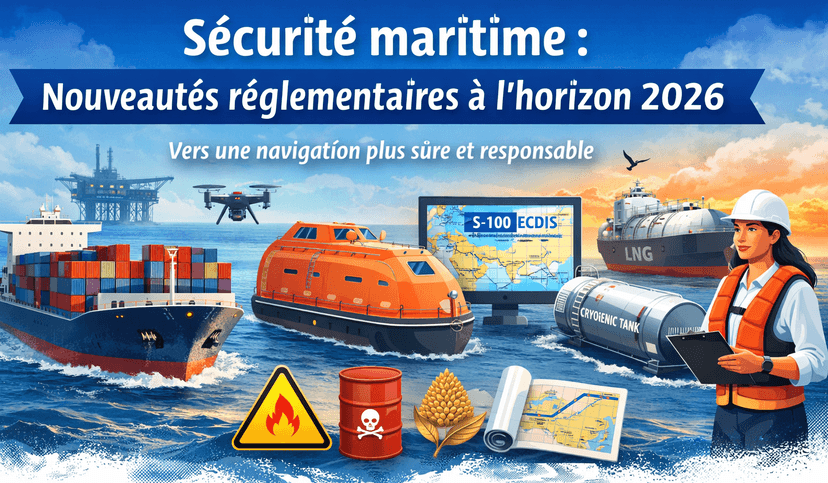
As of 1 January 2026, new IMO rules have come into force, transforming several aspects of maritime operations. They strengthen environmental protection, improve crew training and welfare, and tighten technical requirements for ship safety. Updates to the IMDG and IGF Codes confirm the importance of this regulatory development for the entire maritime sector. Summary: Effective 1 January 2026, the IMO has introduced reforms that raise environmental standards, enhance crew competency and welfare, and tighten ship safety requirements. Revisions to the IMDG and IGF Codes signal a sector-wide regulatory step-change.