Title: SVMO: Transport Canada clarifies the conditions for recognition of sea service
Regulatory context
The SVMO certificate is a national certificate of competency. It authorizes its holder, depending on the characteristics of the vessel, its propulsion power, and the voyage undertaken, to serve as the person responsible for the machinery or the engineering watch.
The SVMO is not an international STCW certificate and its scope is limited to the Canadian regulatory framework. The requirements fall under the Canada Shipping Act, 2001 (CSA 2001), the Marine Personnel Regulations (MPR) and publication TP 2293, which sets out the requirements for seafarers’ examinations and the issuance of certificates and endorsements.
SVMO and SVMO-R: comparative requirements
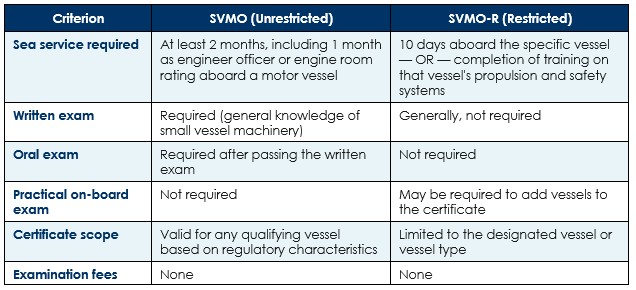
There are two types of SVMO certificates: the SVMO and the SVMO-R, a version with specific restrictions concerning the functions or type of vessel concerned. The following table describes these two certificates in more detail.
Sea service: specific documentary requirements
To be eligible for the SVMO, a candidate must accumulate at least two months of qualifying service, including:
At least one month as an engineer officer or as a rating performing engine-room duties on board one or more motor vessels; and
The remaining time as a combination of the qualifying services provided for in the MPR.

Combined duties can disqualify sea service
This is the most significant element for small operations. Transport Canada specifies that sea service cannot be combined when a candidate simultaneously holds multiple incompatible functions. The explicitly affected combinations are:
Master and engineer officer;
Chief mate and engineer officer;
Deck rating and engineer officer; and
Deck rating simultaneously performing engine-room duties.
In small companies where versatility is common, this clarification may directly affect the length of service recognized—even for an employee with several years of experience.
Two documentary situations depending on the type of vessel
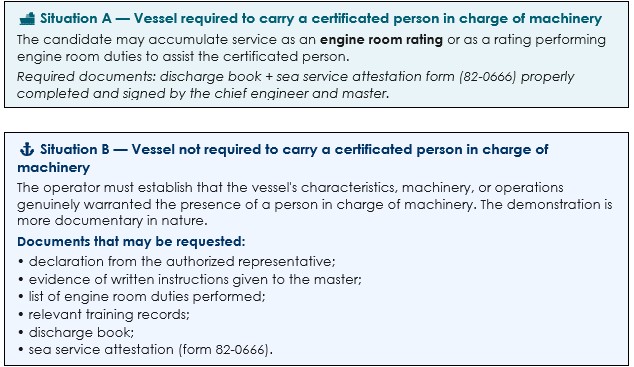
Transport Canada distinguishes two contexts, which call for different documentary approaches.
Additional requirements for the certificate application
In addition to qualifying service, the candidate must gather:
Marine emergency duties and marine basic first aid training (valid certificates required);
Government-issued photo identification;
Proof of Canadian citizenship or permanent residence;
Duly completed forms: 82-0600 (examination application) and 82-0532 (sea service summary);
Successful completion of the written exam on general knowledge of small-vessel engineering;
For the unrestricted SVMO: oral examination after passing the written exam; and
For the SVMO-R: a practical exam on board the vessel concerned may be required.
No examination fee applies.
What this means for operators
The main compliance risk is not limited to the certificate application period. It extends over the entire service accumulation period. Insufficient documentation can render several months of service inadmissible, even when the candidate has significant real-world experience.
Authorized representatives should integrate their employees’ future certification into their document management system from the outset of the pathway.
Recommended checklist for operators
1. Clearly determine the function performed by each candidate on board (deck or engineering — not both simultaneously).
2. Avoid counting, as SVMO service, any period during which a candidate performs incompatible functions.
3. Document, descriptively, the technical functions actually carried out in the engine room.
4. Keep the written instructions given to the master and the relevant training records.
5. Have form 82-0666 (sea service testimonial) regularly completed and signed by the chief engineer and the master.
6. Check that the discharge book corresponds to the testimonials and the functions actually performed.
7. Complete form 82-0532 (service summary) in real time rather than reconstructing the pathway after the fact.
Latitude Maritime analysis
The clarifications published by TC tighten sea service traceability. For small marine enterprises where versatility is necessary, this does not mean that SVMO certification is out of reach. It means that the pathway must be structured and documented from day one. Transport Canada’s web page expressly refers to the CSA 2001, the MPR and TP 2293. The guidance pages facilitate interpretation, but the legislative texts remain determinative in the event of any discrepancy.
Related Articles

Fuel Sampling on Board: What SSB 12/2026 Means for Canadian Vessels
Transport Canada published Ship Safety Bulletin (SSB) No. 12/2026 on 10 August 2026. The bulletin sets out Transport Canada’s policy regarding the installation or designation of fuel sampling points on board Canadian ships, in direct relation to the sulphur content requirements of MARPOL Annex VI. It is particularly relevant to shipowners, operators, technical managers and maritime surveyors responsible for compliance with the rules on fuel sulphur content.
IMO Rules that Entered into Force on 1 January 2026
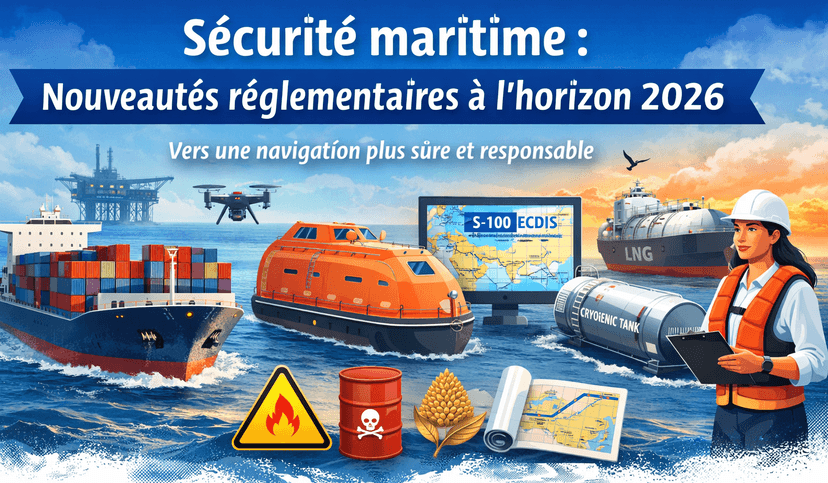
As of 1 January 2026, new IMO rules have come into force, transforming several aspects of maritime operations. They strengthen environmental protection, improve crew training and welfare, and tighten technical requirements for ship safety. Updates to the IMDG and IGF Codes confirm the importance of this regulatory development for the entire maritime sector. Summary: Effective 1 January 2026, the IMO has introduced reforms that raise environmental standards, enhance crew competency and welfare, and tighten ship safety requirements. Revisions to the IMDG and IGF Codes signal a sector-wide regulatory step-change.