The Captain and Bridge Resource Management: A Comparison between the Merchant Marine and the Navy
The hierarchical organization of a vessel directly influences navigational safety, operational management, crew culture, the way the master makes critical decisions, and the responsibility of officers in carrying out instructions, directives, and standing orders. The merchant marine and the navy share several fundamental principles. However, their hierarchical structures and modes of operation serve very different purposes—commercial for the former, operational and tactical for the latter. A ship’s hierarchy shapes safety, operational management, crew culture, the master’s critical decision-making, and officers’ accountability in executing instructions, directives, and standing orders. While the merchant marine and the navy share core principles, their hierarchies and practices are tailored to distinct aims: commercial objectives versus operational and tactical imperatives.
Merchant Marine - a hierarchy governed by the STCW and the CSA 2001
In the merchant marine, the hierarchy aims to ensure vessel safety, protect persons, ensure regulatory compliance, and enhance commercial efficiency. The 2001 Canada Shipping Act defines the master as the person having “command of and charge of the vessel,” responsible for navigation, cargo, and operations at sea and alongside.
The STCW Convention, transposed into the Marine Personnel Regulations (MPR), establishes minimum competencies for officers in navigation, cargo management, safety, leadership, and Bridge Resource Management (BRM). The term “control” refers to the immediate exercise of actions necessary to conduct the ship, without undermining the master’s strategic authority.
Royal Canadian Navy: Military command and tactical management
The RCN falls under the National Defence Act and the QR&O, which structure the chain of
command, disciplinary powers, and officers’ duties. The Commanding Officer of the ship holds full authority—operational, disciplinary, tactical, and organizational—which may be delegated in part, but never relinquished.
Operational Resource Management (ORM), the military equivalent of BRM, emphasizes stress management, interdepartmental coordination, and resilience in a tactical context.
BRM and ORM: two approaches, one shared objective
Despite distinct contexts, BRM (civilian) and ORM (military) both aim to limit human risk and maintain optimal situational awareness.
Command and control in the merchant marine
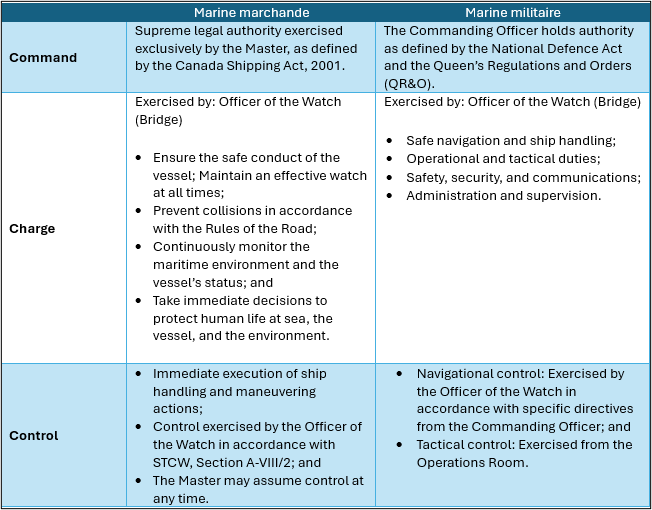
Command denotes the supreme legal authority exercised exclusively by the master, as defined by the 2001 CSA. It covers safety, navigation, cargo, crew, and all operations.
Charge: The Officer of the Watch on the bridge (OOW) must ensure the safe conduct of the vessel, maintain the watch, prevent collisions, conduct continuous monitoring, and make immediate decisions to protect life at sea, the vessel, and the environment.
Control: The immediate execution of conning and maneuvering actions. It is exercised by the officer of the watch in accordance with STCW (section A‑VIII/2), with the master able to resume control at any time. In the civilian context, the term “control” does not always have a single normative definition, but its operational use is consistent.
Command and control in the Navy
In the RCN, the Commanding Officer (CO) or Captain holds authority defined by the NDA and the QR&O.
Command: Command encompasses navigation, safety, discipline, unit leadership, tactical operations, and the use of force.
Charge: The permanent responsibility entrusted to an officer for a functional area, a department, or a specific mission of the ship. Unlike the merchant marine (where charge is primarily functional and tied to the watch), in the RCN, charge is doctrinal and structural.
Control: Control is the immediate and operational exercise of a function: navigation, ship management, tactics, weapons, or sensors. Control is divided into two main categories on a naval vessel:
Navigation control: Exercised by the officer of the watch according to the Captain’s specific directives; and
Tactical control: Exercised in the Operations Room by:
the Officer of the Watch (OOW-Combat); or
The Combat Officer: depending on the level of operations.
Comparative table
Conclusion
Canada applies two distinct hierarchical models aboard ships: a civilian model, regulated internationally, prioritizing safety and efficiency, and a military model, disciplinary and tactical, focused on mission and defence. Officers must have a clear understanding of their responsibilities in relation to the ship’s hierarchical structure when performing their duties.
Despite their differences, both systems share a common priority: ensuring the safety of navigation and protecting human life at sea.